
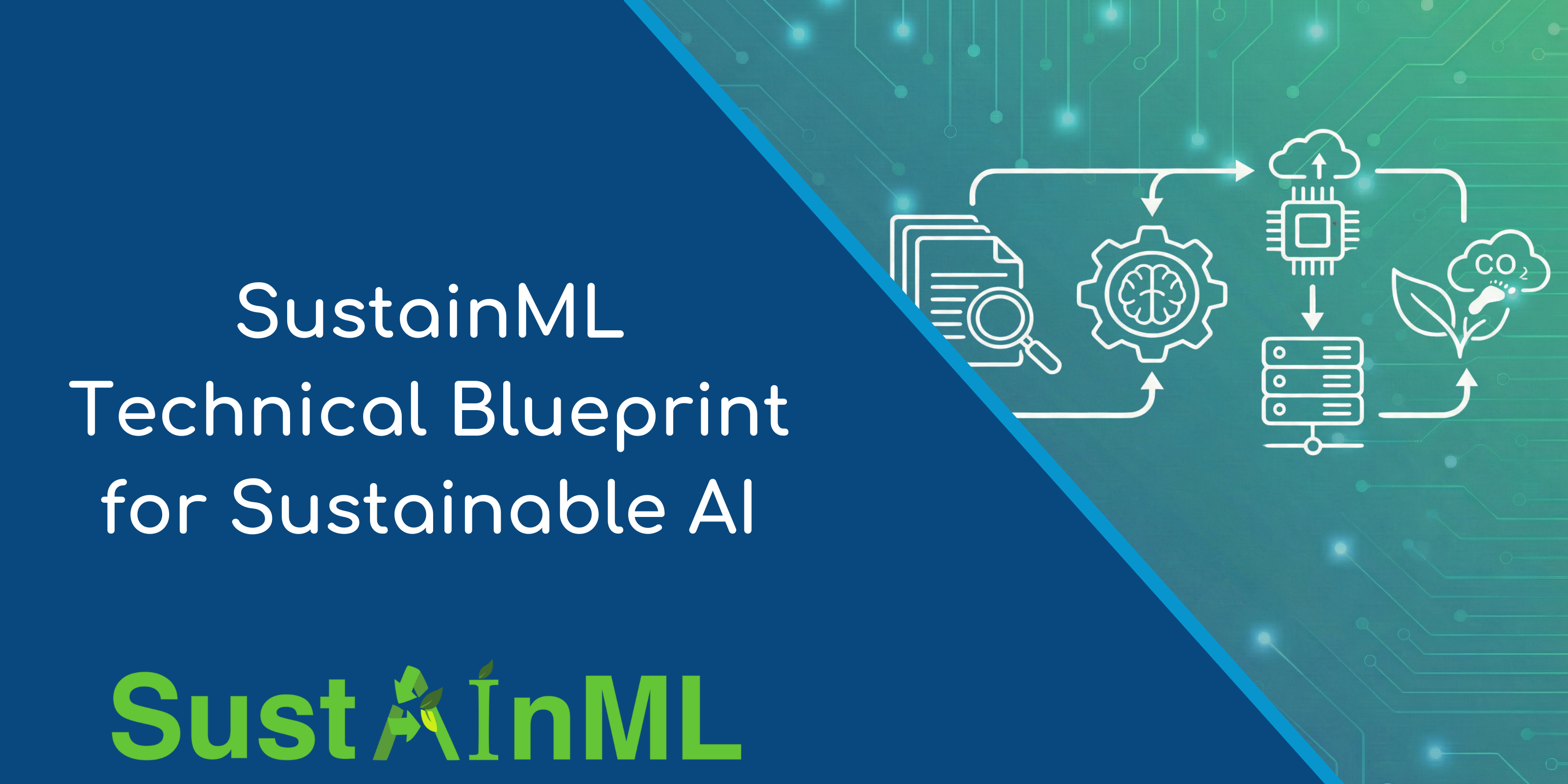
SustainML has reached a major milestone in its mission to build a fully life-cycle-oriented, model–hardware co-design framework for sustainable machine learning: the project’s Scientific Articles portal now hosts 36 publicly available papers, including peer-reviewed publications, conference papers, technical deliverables, architectural reports, prototypes, and community-oriented outputs.
This extensive body of work collectively forms the most complete publicly available resource on Green AI engineering, covering every layer of the ML pipeline, from conceptual modelling to hardware execution, from user-centric design to carbon-footprint tracking.
Overview of the Scientific Output
The documents fall into four major categories:
- Scientific Publications
Journal papers, peer-reviewed studies, conference papers, and methodological contributions on resource-efficient algorithms, uncertainty modelling, quantisation, PIM acceleration, and dataset/memory optimisation. - Technical Deliverables & Design Reports
Architectural documents defining the SustainML framework, task-modelling pipelines, hardware co-design, software architecture, data plans, and explainability modules. - Tools, Prototypes & Benchmarks
Carbon-footprint tools, dashboard prototypes, hardware-in-the-loop experiments, data-efficient benchmarks, and interactive analysis utilities. - Collaboration, Outreach & Environmental Documentation
DMPs, communication reports, collaboration summaries, and guidelines for responsible AI development.
Below is a structured overview of the project’s major achievements, as reflected across these documents.
Key Research Breakthroughs
1. Task Modelling & Knowledge Representation
A central goal of SustainML is to enable developers to describe ML tasks in simple terms and receive sustainable, optimised model-hardware configurations.
Several deliverables are defined:
- A taxonomy of ML problems, covering vision, NLP, sensor processing, structured data, and multimodal tasks.
- A semantic representation layer powered by embeddings and ontologies describing accuracy, latency, memory footprint, and energy constraints.
- A full transition from early TTL-based graphs to a Neo4j-backed knowledge graph, enabling fast queries and expressive reasoning.
These foundations allow SustainML to interpret the needs of the user and translate them into optimizable requirements for carbon-aware design.
2. Efficient Training, Resource-Aware Optimisation & Quantisation
Multiple studies explore how to reduce computational burden during training:
- 8-bit floating-point quantisation methods reduce memory usage while preserving learning stability.
- Analyses of how training setups influence energy demand demonstrate measurable variability between architectures, batch sizes, and optimisation schemes.
- Energy-aware neural architecture search (NAS) benchmarks integrating both accuracy and energy costs into search objectives.
- Dataset condensation and coreset methods that reduce training set size without sacrificing generalisation.
This body of work shows, with hard empirical evidence, how small architectural or dataset decisions drastically change energy demand, allowing SustainML to make informed, sustainable recommendations.
3. Hardware Acceleration & Processing-in-Memory (PIM)
A complete set of hardware-oriented document analyses:
- PIM architectures using UPMEM memory processing units, evaluating speed-ups and energy savings across ML workloads.
- FPGA-based accelerators with RTL implementations for sensor-based applications.
- Hardware predictors integrated into the SustainML ecosystem (e.g., RPTU latency predictor).
- Reports on data movement, memory bottlenecks, and low-power inference, bridging hardware-software interactions.
These outputs connect high-level ML design with chip-level execution, allowing the framework to recommend the right hardware for a given energy budget.
4. Human-Centred and Explainable ML
Several documents focus on the human element:
- Studies assessing awareness of sustainability in ML and HCI communities.
- Experiments with user-guided model exploration interfaces.
- Deliverables on explainability tools that justify decisions not only in terms of accuracy, but also carbon footprint and resource cost.
This ensures sustainable AI is not only technically efficient but also understandable and actionable for practitioners.
5. Framework Architecture, Front-End, and Back-End Design
The design documents for the framework outline:
- A full front-end and back-end architecture for the SustainML developer tools.
- Interaction between the UI, graph database, hardware predictors, carbon calculators, and orchestration modules.
- Prototype releases showing multi-tab problem definitions, comparison workflows, iterative experimentation, and metadata extraction.
These deliverables demonstrate that SustainML is not just theoretical research, but a working software ecosystem ready for integration and experimentation.
6. Carbon Footprint Tracking & Sustainability Metrics
Documents in this area include:
- A prototype carbon footprint–aware model optimisation tool.
- Methodologies for tracking energy consumption across:
- Data pipelines
- Training epochs
- Inference deployments
- Guidelines for reducing emissions in computational research.
This makes it possible to choose models not just by accuracy, but by CO₂ saved per inference or energy-per-epoch, making sustainability quantifiable.
7. Collaboration, Dissemination & Open Science
The final cluster of documents includes:
- Annual collaboration reports.
- Communication & dissemination strategies.
- Open-source integration notes, ensuring transparency and reuse.
These outputs ensure SustainML becomes a community resource, not just a research project.
Summary
SustainML’s expanding portfolio of scientific and technical documents marks a major leap forward for the field of sustainable machine learning. With contributions spanning quantisation, NAS, hardware acceleration, HCI studies, documentation, and system architecture, the project provides a blueprint for how to build ML systems that are powerful, explainable, and environmentally responsible.
These papers represent more than research; they constitute a complete ecosystem for Green AI, ready to be leveraged by developers, researchers, and industry partners.








 This project has received funding from the European Union’s Horizon Europe research and innovation programme under grant agreement No 101070408.