
The SustainML platform continues to evolve with new capabilities designed to simplify the development of sustainable artificial intelligence systems. In the latest update, SustainML introduces a new integration with the Hugging Face ecosystem that enables users to discover, inspect, and evaluate machine learning models directly within the platform.
At the core of this integration is the Model Context Protocol (MCP). MCP is a lightweight communication layer designed to allow AI systems and tools to interact with external resources and services in a structured way. In the context of SustainML, the MCP server acts as an intermediary between the SustainML platform and the Hugging Face Hub, enabling the system to query models, retrieve relevant metadata, and deliver model suggestions directly to the user interface. By introducing MCP into the architecture, SustainML can connect seamlessly to large model repositories while keeping the core platform modular and extensible.
Bridging Model Discovery and Sustainability Analysis
Selecting the right machine learning model is a critical step in the development of AI applications. Traditionally, developers search external repositories such as Hugging Face to identify suitable models, and then manually evaluate their performance and deployment requirements. However, this process rarely takes environmental impact into account.
The new SustainML integration addresses this gap by connecting the platform directly to Hugging Face through an MCP-based service layer. This MCP server acts as a bridge between SustainML and the Hugging Face Hub, allowing the platform to query models dynamically and retrieve relevant information needed for further analysis.
Through this integration, users can now search for models based on their task description and instantly access suggestions that are relevant to their machine learning problem. Once a model is selected, SustainML can evaluate it using its existing analysis pipeline, estimating metrics such as power consumption, carbon footprint, and other sustainability indicators depending on the available hardware configuration.
This approach brings together two essential aspects of modern AI development: model discovery and environmental impact evaluation.
Semantic Model Search
A key innovation in this update is the introduction of semantic model search. Instead of relying solely on simple keyword matching, the new system uses transformer-based embeddings to understand the meaning of the user's query.
The MCP server processes the query using a sentence embedding model and compares it with a large index of model representations. By measuring semantic similarity between the query and model descriptions, the system identifies models that are most relevant to the user's intended task.
This semantic search mechanism allows SustainML to recommend models even when the query does not exactly match the wording used in the model documentation. As a result, the platform can provide more meaningful suggestions and help users discover models that might otherwise remain hidden in large repositories.
The search results are then returned to the SustainML interface, where they are presented to the user in a structured list of recommended models.
Interactive Model Exploration
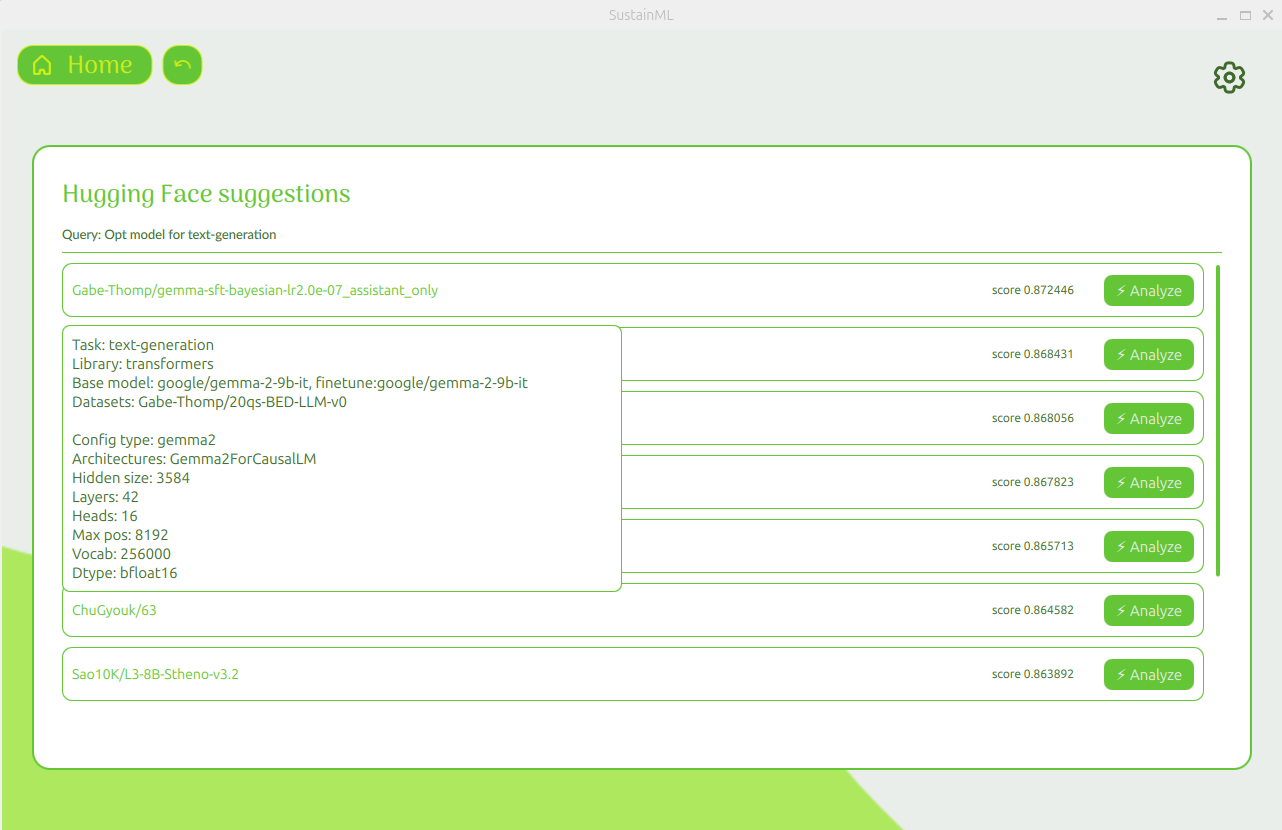
To make model exploration easier, the SustainML interface has been extended with a dedicated view for Hugging Face model suggestions. Within this interface, users can browse recommended models and interact with them directly.
Each model entry includes an interactive tooltip that provides additional information about the model, such as its description and relevant metadata. These tooltips help users quickly understand the characteristics of each model without leaving the SustainML platform.
In addition, users can open the corresponding Hugging Face model page directly from the interface if they wish to explore further documentation or implementation details.
This interactive design ensures that model discovery remains both efficient and informative.
One-Click Sustainability Analysis
The most powerful feature introduced in this update is the ability to launch sustainability analysis directly from the Hugging Face model list.
With a single click, users can select a suggested model and initiate the SustainML evaluation pipeline. The system then runs the standard analysis workflow, which estimates relevant sustainability metrics based on the selected hardware configuration and task definition.
These metrics may include:
- estimated power consumption,
- carbon footprint,
- and the carbon intensity of the deployment scenario.
By integrating model discovery and sustainability evaluation into a single workflow, SustainML helps developers make more informed decisions when choosing machine learning models.
Instead of focusing solely on accuracy or popularity, users can now consider environmental impact as an integral part of the model selection process.
Architecture Based on MCP
The integration relies on a dedicated Model Context Protocol (MCP) server that acts as an intermediary between SustainML and external model repositories.
The MCP server is responsible for:
- handling model search requests,
- performing semantic ranking of models,
- retrieving metadata and descriptions from the Hugging Face Hub,
- and returning structured results to the SustainML platform.
This architecture provides several advantages. It decouples the external model discovery logic from the SustainML core platform and allows the search system to evolve independently. New search strategies, ranking mechanisms, or external repositories can be integrated in the future without modifying the main SustainML interface.
Moreover, the MCP server can cache and manage model metadata efficiently, enabling faster searches and more scalable integration with large model repositories.
Supporting Sustainable AI Development
The new Hugging Face integration represents an important step toward making sustainability considerations a natural part of AI development workflows.
By combining model discovery with environmental impact analysis, SustainML encourages developers to evaluate not only the performance of their models but also their sustainability implications.
Looking Ahead
This integration opens the door to further enhancements in the SustainML ecosystem. Future developments may include deeper model metadata analysis, expanded support for additional model repositories, and more advanced sustainability estimation methods.
By continuing to connect modern AI tooling with sustainability-focused evaluation, SustainML aims to support the development of AI systems that are not only powerful and effective, but also environmentally responsible.








 This project has received funding from the European Union’s Horizon Europe research and innovation programme under grant agreement No 101070408.