
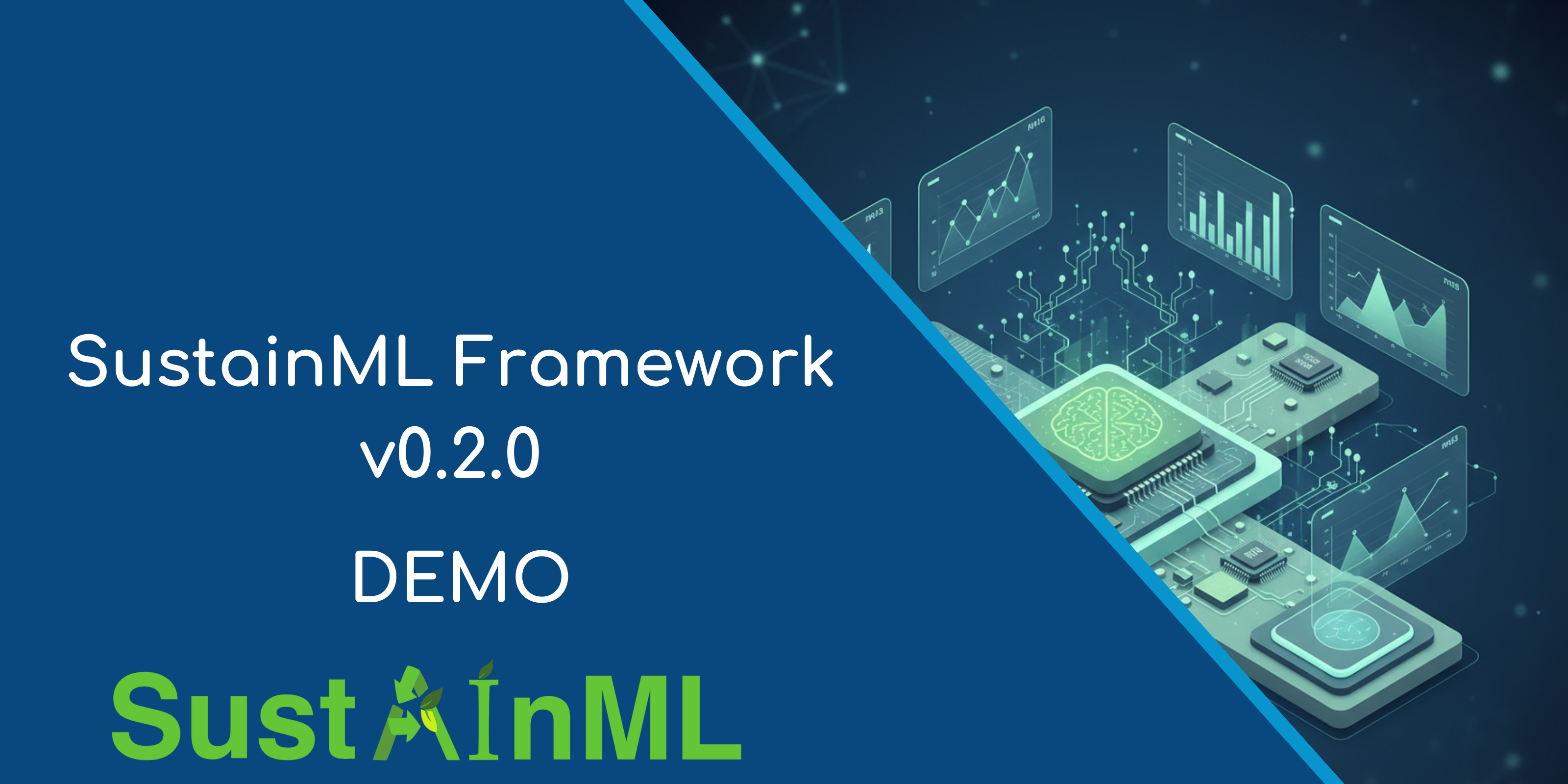
The SustainML Developer Framework v0.2.0, built by eProsima, provides a unified and extensible interface to the backend services and the core SustainML_Library v0.2.0.This release enhances stability, visualization, and hardware integration, while preserving the simple, modular workflow that defines SustainML.
Through its backend, the framework enables you to:
🧩 Define ML Problems
Specify the task you want the AI to solve—describe the problem statement, choose input and output modalities, set evaluation metrics, and define dataset constraints.
Now, inputs are preserved when navigating between screens, and a new “New Problem” button allows you to start from a clean definition at any time.
⚙️ Customize Goals & Hardware
Choose a predefined ML goal (e.g., classification, regression) and target hardware (CPU, GPU, PIM), or manually select your preferred model and device for precise testing.
This version introduces RPTU hardware integration, enabling latency-aware predictions and preparing the groundwork for power consumption analysis in future updates.
🔁 Run Iterative & Comparative Experiments
Submit multiple iterations within a session—reusing previous state or testing new model/hardware configurations.
The Results screen now prevents accidental reiteration or screen switching during task execution, while multiple comparison tabs and dynamic tab naming make side-by-side analysis clearer than ever.
📊 Gather & Compare Performance Data
After each run, the framework collects latency, power consumption, carbon footprint, and custom metrics—displayed in interactive tables and charts.
The Comparison view now automatically updates after each iteration, includes units directly on graph axes, and provides “More Info” popups for deeper insights into result variables.
You can also rename tabs, maintain them when switching screens, and view Iteration details in a cleaner table format.
🧠 Work with Rich Metadata
SustainML v0.2.0 extends metadata awareness across the workflow:
- Automatic extraction of dataset metadata from dataset paths.
- Inclusion of dataset metadata inside the ML Model Metadata Node.
- Enhanced Neo4j-based knowledge graph queries replacing the previous TTL-based system.
- Integrated DFKI RAG and RPTU predictors for reasoning and hardware-aware insights.
All these capabilities are exposed through the SustainML_Library v0.2.0 API via its REST API-based interface, enabling both Python and C++ developers to orchestrate sustainable, hardware-aware ML experiments—efficiently and reproducibly.
Installation and running
This tutorial will show how to install and use this framework through source installation, with its dependencies, or using docker:
- Source Installation & run –-> Linux installation and run
- Docker –-> Docker Installation and run
Demo
The following video provides a step-by-step walkthrough of how to use the main functionalities of the SustainML Framework v0.2.0.
VIDEO






 This project has received funding from the European Union’s Horizon Europe research and innovation programme under grant agreement No 101070408.