
Researchers Mengxi Liu, Sizhen Bian, Zimin Zhao, Bo Zhou, and Paul Lukowicz from the German Research Centre for Artificial Intelligence (DFKI) have introduced an innovative approach to real-time eye blink detection using capacitive sensing technology. Their paper, “Energy-efficient, low-latency, and non-contact eye blink detection with capacitive sensing”, presents a lightweight, wearable prototype embedded into a pair of standard glasses—eliminating the need for cameras or skin contact.
This work reflects DFKI’s continued commitment to developing sustainable, privacy-respecting, and user-friendly sensing solutions for human–computer interaction, wearable computing, and assistive technologies.
A New Vision for Blink Detection
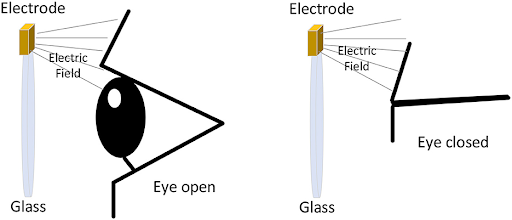
Unlike conventional methods based on cameras or skin-worn electrodes, the DFKI system utilises a single copper electrode mounted in the glasses frame. As the eyelid moves during a blink, it subtly changes the capacitance between the skin and the sensor, allowing the system to detect blinks in real-time without touching the skin or capturing images.
This capacitive sensing approach addresses key limitations of existing solutions:
- No cameras → enhanced privacy
- No contact → higher comfort and wearability
- Low power draw → enables all-day, untethered use
Tested in Real-World Scenarios
The team evaluated the system with eight participants across five daily scenarios: intentional blinking, reading, speaking, walking, and driving simulation. Results show:
- 92% precision and 94% recall using a user-specific threshold model
- 80% precision and 81% recall with a lightweight, user-independent decision tree model
- <1 mW power consumption, suitable for long-term use
- 20+ hours runtime on a 300 mAh battery
The entire device—including microcontroller, Bluetooth, sensing unit, and battery—weighs only 18 grams, offering a seamless and comfortable user experience.
Sustainable, Ultra-Low-Latency Sensing
To ensure sustainability and energy efficiency, the DFKI team designed a streamlined sensing and processing pipeline. They used a frequency-based LC oscillator to detect capacitance changes from eyelid movement, and replaced complex neural networks with a lightweight decision tree classifier for fast, on-device inference. By processing data in a 2-bit quantised format, the system achieves significant reductions in memory and computation needs. This architecture enables low-latency blink detection under 100 milliseconds without relying on cloud services or heavy hardware, making it ideal for real-world, low-power wearable applications.
Applications Beyond Eye Blink Monitoring
The system’s capabilities extend into diverse domains:
- Assistive tech for users with motor impairments
- Fatigue detection in driving or industrial settings
- Gesture input in AR/VR and wearable interfaces
The researchers also highlight potential future enhancements, including multi-electrode eye tracking, online learning models, and customised hardware designs for better fit and robustness during dynamic activities.
Toward Human-Centric Wearable Intelligence
This work marks a significant step toward real-world, energy-efficient, and inclusive eye monitoring solutions. By removing the barriers of contact, computation, and camera-based privacy, DFKI demonstrates how capacitive sensing can transform the landscape of wearable HCI systems.
The research was supported by the Horizon Europe SustainML project, furthering its mission to embed sustainability and usability throughout the AI lifecycle.








 This project has received funding from the European Union’s Horizon Europe research and innovation programme under grant agreement No 101070408.