
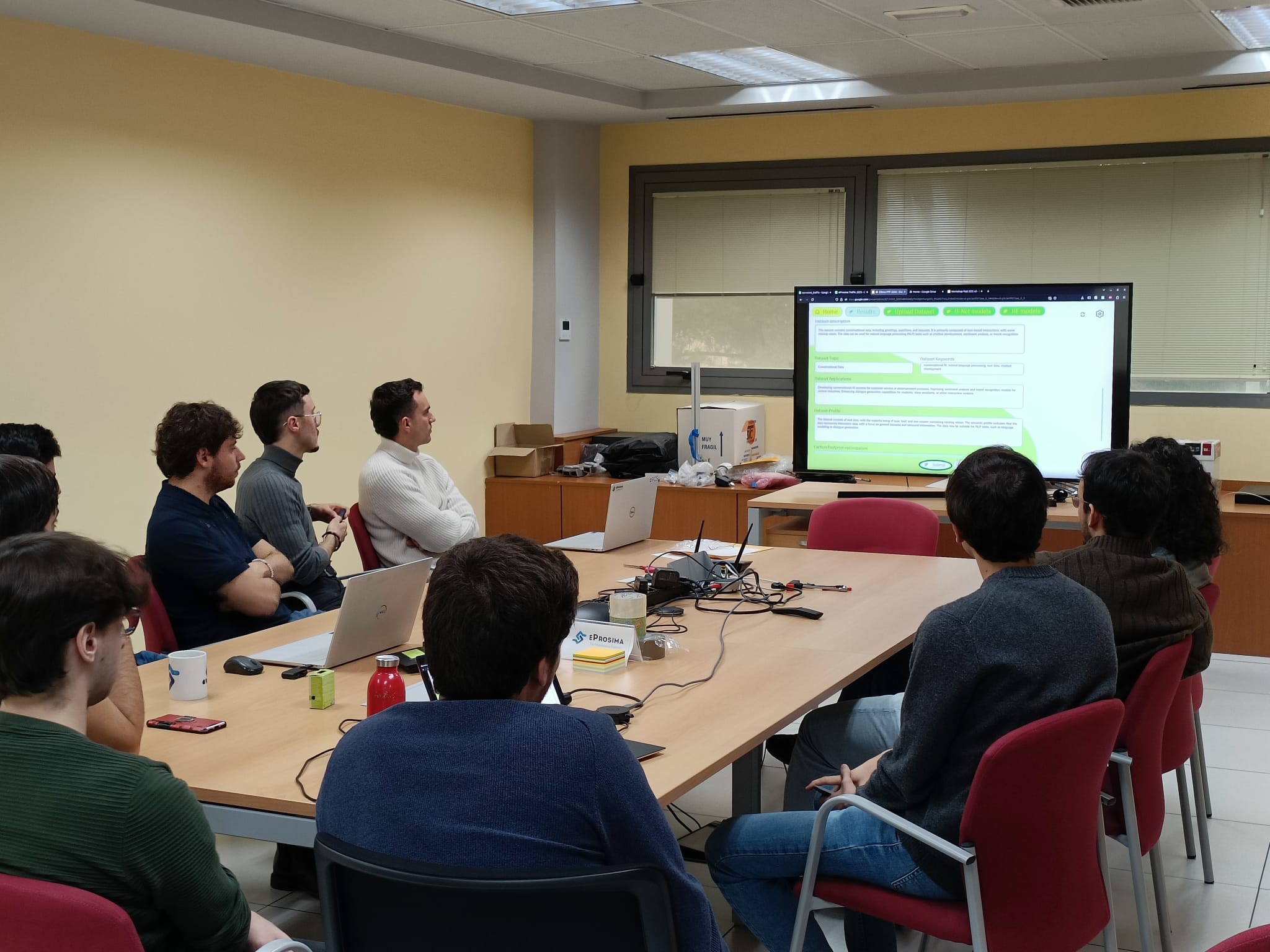
On February 5th, 2026, eProsima held its internal SustainML 2026 Kick-Off Meeting, bringing together the team involved in the project to review the progress achieved during 2025 and to align on objectives and priorities for the year ahead.
The meeting marked an important milestone to close the 2025 work cycle, acknowledge the results achieved by the team, and define a clear and shared direction for 2026, reinforcing eProsima’s commitment to the SustainML project.
Looking Back at 2025: A Year of Progress and Consolidation
The first part of the meeting was dedicated to a retrospective of SustainML’s progress during 2025, with a particular focus on the contributions made by the eProsima team.
Throughout the year, SustainML advanced from early designs toward more mature and integrated technical solutions supporting sustainable, efficient, and trustworthy machine learning systems. The discussion highlighted how different components of the platform evolved and how they were progressively integrated.
Key achievements presented included:
- The integration of core SustainML components, enabling smoother interaction between nodes
- The development and enhancement of node services, supporting communication between them as well as orchestration, and execution of machine learning workflows
- The addition of new features aimed at improving usability, performance, and sustainability-related metrics
- Improvements in architecture and interoperability, facilitating integration with other project components and external systems
In addition, the team showcased a demonstration of the SustainML API, illustrating how the developed interfaces can be used to interact with the platform and manage its services. This demo provided a concrete view of the progress achieved and helped connect the technical work with practical usage scenarios.
Overall, the retrospective highlighted not only tangible results but also valuable lessons learned during implementation, integration, and experimentation activities.
eProsima’s Contributions to SustainML
A dedicated segment of the meeting focused on eProsima’s specific role and impact within the SustainML project. The team reviewed how its expertise contributed to advancing the platform in areas such as system design, service integration, performance, and sustainability-oriented approaches.
The discussion emphasized the continuous effort to ensure that developed solutions are robust, scalable, and aligned with real-world requirements, while maintaining close coordination with the broader SustainML consortium. This exchange reinforced a shared understanding of how eProsima’s work supports the overall project vision.
Setting the Course for 2026
The second half of the meeting looked ahead, with the presentation and discussion of the goals and priorities for 2026.
Building on the foundations established in 2025, the team outlined objectives focused on:
- Further extending and refining platform features
- Addressing identified improvement areas based on previous experience
- Continuing collaboration and alignment within the SustainML consortium
These goals aim to consolidate the platform and move closer to practical, deployable, and sustainable machine learning solutions.
Looking Ahead
With a solid technical base established during 2025 and a well-defined roadmap for 2026, eProsima is well-positioned to continue contributing actively to the success of SustainML. The kick-off meeting helped align the team around common objectives and set the tone for another year of focused and impactful work.





 This project has received funding from the European Union’s Horizon Europe research and innovation programme under grant agreement No 101070408.